A fuel tank reading is only useful when you know what the transmitter actually measured: the distance to the liquid surface, the liquid level from a defined reference point, or a calculated volume. By following the signal path, checking the tank geometry and comparing the right specifications, you can decide whether a radar instrument will produce a dependable fuel reading in your installation.
Key takeaways
- Radar converts microwave echo time into distance, then subtracts distance from tank reference height.
- Choose frequency, antenna, accuracy and measurement range for the tank and fuel conditions.
- Keep the antenna clear of walls, ladders, pipes and other echo-producing internals.
- Commission empty and full references before linking the reading to alarms, pumps or valves.
From microwave echo to fuel level, distance and volume
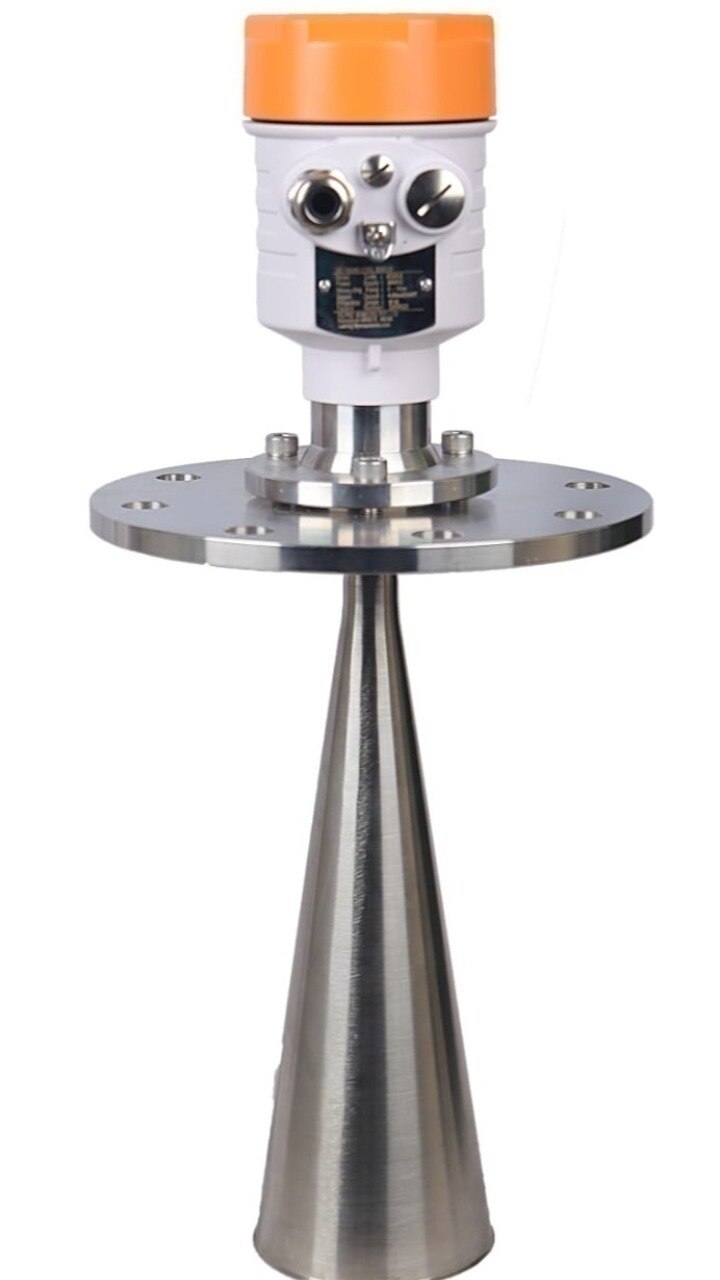
The transmitter sends microwave energy from its antenna toward the fuel surface, receives the reflected echo, and calculates the signal’s round-trip travel time. A non contact level transmitter then converts that distance into level: level equals the tank reference height minus the measured distance.
The reference point is usually the antenna face, so an incorrect nozzle height creates a consistently wrong reading.
Radar level transmitter explained: free-space radar travels through the tank atmosphere without touching the fuel. Guided-wave radar sends its signal along an immersed rod or cable, so buildup, mechanical loading and material compatibility become part of the measurement.
| Radar technology | How range is calculated | Practical distinction |
|---|---|---|
| Pulse radar | Measures microwave time of flight | Sends discrete pulses and measures their return |
| FMCW radar | Measures the frequency difference between transmitted and received signals | Continuously sweeps frequency to derive range |
The instrument reports distance or level, not fuel inventory by itself. To obtain volume, the control system applies a geometric calculation, tank strapping table or calibration table to the measured level; mass additionally requires a fuel density value or separate mass measurement.
A strong, sharply defined surface echo gives the most stable result, while a single echo cannot guarantee a fuel/water interface reading in emulsified or foaming product.
Which radar specifications determine whether a fuel tank will measure well?
Match the transmitter to the tank’s geometry, vapour conditions and control task, not simply to “diesel” or “petrol.” A non-contact level transmitter for radar fuel tanks measures distance to the surface; it does not infer volume from density or mass from level.
Convert level to volume with a strapping table or tank geometry, and calculate mass with a density value or separate mass measurement.
| Option | Signal method | Best fit | Main limitation |
|---|---|---|---|
| Pulse radar | Time of flight of microwave pulses | General tank level measurement | Check echo strength and dead zone |
| FMCW radar | Frequency difference between transmitted and received signals | Precise continuous ranging and stable process readings | Match frequency band, range and configuration |
| Guided-wave radar | Signal travels along an immersed rod or cable | Interface or difficult vapour conditions | Probe buildup, mechanical loading and fuel compatibility |
Specify these points before ordering:
- Measuring range must cover the lowest level to the highest credible level, while the near-zone or blocking distance must clear the antenna and nozzle. A high-level tank can lose usable range at the top.
- Check beam angle against tank diameter and internal obstructions, then select antenna material, process connection, enclosure rating and power supply for the installation.
- State accuracy, repeatability and response time. Inventory, pump control and overfill protection need different output performance.
- Foam, condensation, heavy vapour or buildup require a stronger echo margin. Filpro Sensors Pvt Ltd can use the tank drawing and output requirement to identify mismatches before installation.
- Request 4–20 mA, HART, RS-485 or a switching output according to the receiving control system. Treat interface detection as a separate specification: fuel-water measurement needs two clear echoes, not one assumed reflection.
Related product
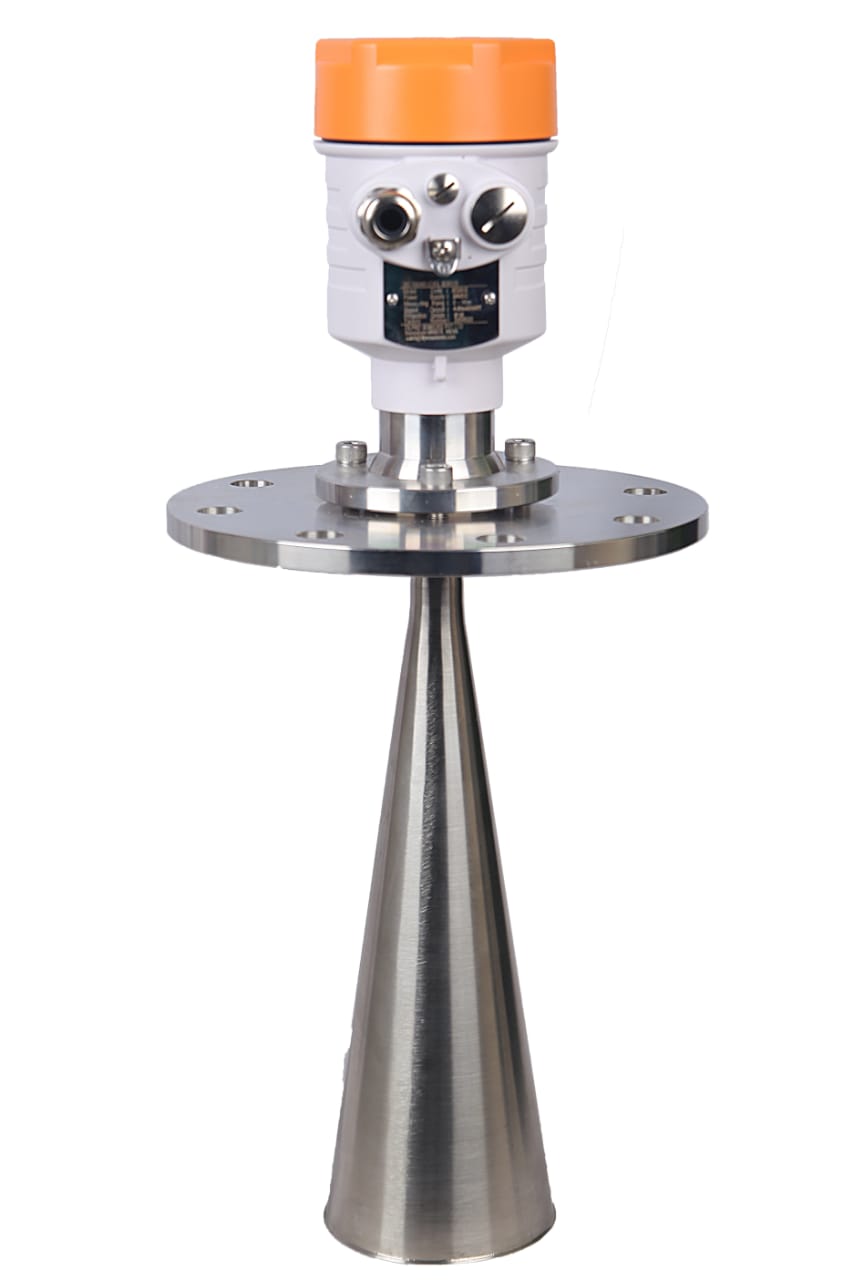 | Level Transmitter FILPRO offers professional Radar Level Transmitter. Our radar level transmitter uses radar to continuously measure non-contact liquid level, the... View product → |
How tank geometry and installation protect the radar signal
Mount a radar level sensor in a fuel tank from the roof, over the calmest open area, with the antenna aimed straight at the liquid surface.
A centred location usually gives the cleanest return; a side position sends energy toward the wall, roof, ladder or internal piping and can make a stationary object look like the fuel level.
Keep the antenna outside the path of anything that can reflect or scatter the signal:
- Move it away from inlet pipes, outlet pipes, mixers, heating coils, ladders, braces and roof supports.
- Keep the antenna clear of the tank wall and avoid mounting directly above a filling stream.
- Align the antenna perpendicular to the expected fuel surface; compensate for a sloped roof with the mounting arrangement, not by leaving the antenna tilted.
- Size the nozzle so its inside wall does not obstruct the beam, and keep the antenna tip below the nozzle only within the transmitter’s permitted dead-zone limits.
- Check the highest credible fuel level against the transmitter’s blocking distance; a full tank can place the surface inside the unreliable zone.
A radar level sensor fuel tank installation also needs a clean antenna face and a dry, stable process connection. Condensation or fuel residue on the antenna weakens the already modest reflection from low-dielectric hydrocarbon fuel.
If internals cannot be avoided, choose an antenna and beam angle that keep them outside the measurement path, or use a stilling tube designed for the tank and fuel.
How vapour, foam and tank internals change the returned echo
The returned echo gets weaker when the fuel surface is aerated, obscured or electrically hard to distinguish from the tank atmosphere. Hydrocarbon fuel has a low dielectric constant, roughly 1.8–2.2, so its reflection is already weaker than water’s; a non contact level transmitter depends heavily on a clean antenna and a sharply defined surface.
The main conditions that distort the echo are:
- Foam scatters microwave energy and produces a broad, unstable reflection instead of a clear surface point.
- Emulsions and heavily mixed fuel blur the boundary between fuel and water.
- Heavy vapour reduces signal strength in the space above the liquid.
- Condensation on the antenna face attenuates the signal and shifts the apparent level.
- Product buildup changes the antenna’s effective signal path and creates a false near-surface echo.
- A beam striking a ladder, brace, pipe or heating coil returns an echo that can imitate the fuel surface.
A radar level sensor fuel tank installation becomes difficult when the strongest echo comes from an obstruction rather than the liquid. Signal processing can reject known fixed targets, but it cannot reliably correct a moving foam layer or changing internal deposits.
Water can produce a strong secondary echo beneath hydrocarbon fuel, allowing interface measurement only when both surfaces return separately. An emulsified or vigorously mixed layer can merge those echoes, so do not treat one apparent reflection as proof of a fuel-water interface.
Inspect the echo profile during filling, emptying and agitation before using it for control decisions.
How to commission the reading and connect it to safe tank control
Verify the displayed level against an independent reference at more than one known level before using it for inventory, interface, or overfill decisions.
1. Confirm the transmitter’s reference point, empty distance, full distance, tank height, nozzle orientation, and entered blocking distance. Level equals reference height minus measured distance; an incorrect datum shifts every reading.
2. Check the actual tank drawing and strapping table against the configuration. A radar level transmitter does not measure volume or mass directly. Use the verified level with tank geometry or strapping data for volume, then apply a verified density value for mass.
3. Record the echo profile with the tank empty or at a documented level. Mark false echoes from the nozzle, ladder, agitator, roof, or heating coil, then confirm that the selected surface echo moves when the fuel level changes.
4. Compare the display with a calibrated dip tape, certified gauge, or sight reference at low and high levels. Record temperature, level, reference method, and difference; investigate a repeatable offset instead of hiding it with a calibration adjustment.
5. Prove the control response by simulating the configured 4–20 mA, HART, or digital values at alarm thresholds. Confirm independent high-high shutdowns, voting logic, alarm delays, loss-of-signal behavior, and the final valve or pump action.
A non contact level transmitter for radar fuel tanks measures the free-space surface without a probe. A radar level transmitter explained plainly differs from guided-wave radar, whose rod or cable contacts the fuel and brings separate buildup and compatibility risks.
Foam, vapour, condensation, or an emulsion can still make interface readings unreliable; never treat one echo as a guaranteed fuel-water boundary.
Frequently asked questions
How does a radar level transmitter measure fuel without contact?
It sends microwave energy toward the fuel surface, measures the returned echo’s round-trip time, and converts that distance into level using the tank reference height.
Which radar specifications matter for a fuel tank?
Check operating frequency, antenna type, measurement range, accuracy, beam angle, process temperature and pressure limits, and the transmitter’s output and communication options.
How do tank geometry and installation affect radar measurement?
Install the antenna with a clear view of the fuel surface and keep it away from tank walls, ladders, pipes, braces and other objects that can create false echoes.
How do vapour, foam and tank internals affect the returned radar echo?
Vapour, foam and internal structures can weaken, scatter or compete with the surface echo, so configure echo handling and verify the reading under actual tank conditions.
How do you commission a radar reading for safe tank control?
Set the tank reference and measurement limits, compare the reading with a known level, test alarms and outputs, and confirm pump or valve actions before putting the loop into service.