For a local tank reading across a yard or process area, a magnetic level gauge is usually easier to see than glass because its external flags or rollers create a high-contrast level indication. The right choice depends on the viewing distance, scale size, line of sight, tank geometry, liquid properties and whether “remote” means a nearby operator or a control-room display.
Key takeaways
- Choose a magnetic gauge for clear local reading without viewing the liquid through glass.
- Specify readable distance, viewing angle, display contrast and lighting before requesting quotes.
- Match the gauge to tank height, liquid properties, temperature and pressure.
- Use ultrasonic or transmitter options when readings must reach a remote control point.
The best local gauge for a 10 m, 25 m or tank-farm view
A magnetic level gauge is the strongest starting point when you need a tank level gauge readable from distance at the tank itself. Its float sits in a sealed bypass chamber and moves external red-and-white or yellow-and-black flags, rollers or a pointer, so you do not need to resolve a liquid line through glass.
| Option | Best viewing position | Distance and visibility limits | Main trade-off |
|---|---|---|---|
| Magnetic level gauge | Tank base, walkway or nearby operating area | Strongest choice for 10 m, 25 m or a tank-farm view when the indicator is tall, high-contrast and well lit | Local indication; flags do not send a control-room signal |
| Float-and-board gauge | Ground level or an elevated walkway | Large board and pointer can remain visible across an atmospheric storage area | Exposed to rain, dust, cable stretch, pulley wear and impact |
| Glass or reflex gauge | Close inspection at the tank | Poorer for long-distance reading because glare, fouling, vapour and viewing angle obscure the liquid line | Direct sight, but a narrow visual target |
| Radar instrument | Control room, PLC or SCADA display | Genuinely remote when connected to a display | Requires a separate local display for a large tank-side scale |
Before ordering, confirm:
- Viewing distance: 10 m, 25 m or across the tank farm
- Indicator height, board dimensions, numeral size and scale increment
- Lighting, background contrast and viewing angle
- Whether reed switches, a magnetostrictive transmitter or another sensor is needed for remote measurement
There is no universal readable-distance rating. Specify the viewing point and require the supplier to confirm visibility at that location.
What makes a gauge readable from the ground, walkway or control point
Specify readability as an observation task: at what maximum distance must the operator distinguish the smallest level change, from what observer height, viewing direction and position?
State whether the operator stands at ground level, on an elevated walkway or at a control point; “visible from a distance” is not a usable requirement for a tank level gauge readable from distance.
A tall indicator with large numerals and high-contrast red/white or yellow/black flags is easier to read across 25 m than a compact scale with fine graduations.
A sharply off-axis view can hide flags, compress numerals and create reflections, so measure the line of sight from the normal operating position around nearby tanks, pipe racks and roof structures.
Record these specification points:
- Maximum viewing distance, operator eye height and required level increment
- Viewing direction, viewing angle and whether the location is ground, walkway or control point
- Indicator height, scale length, numeral size, scale division, pointer or flag colours and contrast
- Direct sun, glare, rain on a window, dust, night operation and low-visibility conditions
- Readability during power failure; a magnetic indicator remains passive, while a backlit electronic display needs power, a suitable enclosure and planned illumination
- A drawing showing the indicator, line of sight, obstructions and the manufacturer’s stated viewing basis
For control-room reading, specify a remote display connected to the instrument, PLC or SCADA system rather than assuming a local gauge can be seen through a window.
How magnetic, glass, ultrasonic and transmitter options compare
| Option | What it means | When it applies |
|---|---|---|
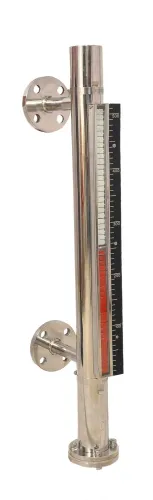
| Magnetic level gauge | A float in a bypass chamber moves external magnetic flags, giving passive local indication without exposing the liquid through glass. | Choose it for stand-off viewing on a tank with a suitable bypass chamber; add reed switches or a transmitter for remote measurement. |
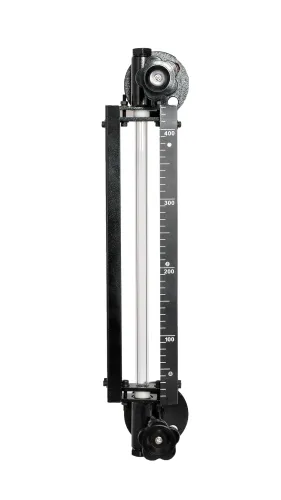
| Reflex, transparent or tubular glass | Shows the liquid line directly through a visible assembly. | Choose it for close-range confirmation when the process permits glass. Glare, fouling, vapour and poor lighting reduce readability. |
| Float-and-board indicator | A roof-mounted float moves an external graduated board. | Choose it for atmospheric or low-pressure storage where a large mechanical scale matters more than a sealed chamber. |
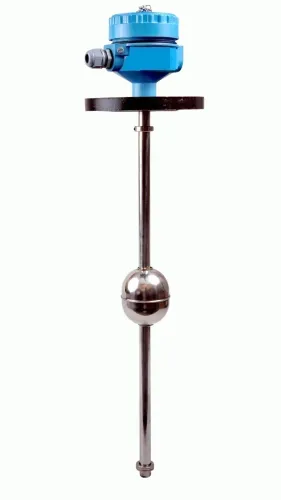
| Float or hydrostatic transmitter | Converts float position or liquid pressure into a continuous electrical signal. | Choose it for control-system measurement after checking density, pressure, temperature, vapour and installation conditions. |
| Ultrasonic measurement | Measures level without contacting the liquid. | Choose it when the roof, vapour, foam, turbulence, obstructions and acoustic conditions support reliable echoes. |
| Radar | Sends a digital level value to a remote system. | Choose it when “readable from a distance” means a control-room, PLC or SCADA value; add a display for local reading. |
For a tank level gauge readable from distance at the vessel, magnetic indication is usually more practical than glass. A float-and-board scale suits simple storage but leaves cables, pulleys and the board exposed to weather and damage.
Treat every local gauge as an indication device, not independent overfill protection. Use a separate, engineered high-level switch or shutdown layer when overflow consequences demand it.
Match the gauge to the tank and liquid before comparing visibility
Match the gauge to the tank and liquid before comparing visibility. A gauge that is easy to see can still give a wrong level if its process connections, float or signal path do not suit the installation.
1. Record the maximum liquid level, tank height, diameter, roof arrangement, nozzle position and distance between the tank and operator. These dimensions determine where the indication can be mounted and whether the viewing path remains usable.
2. For a magnetic level gauge, provide correctly located upper and lower process connections. Leave enough access to isolate, drain, vent and clean the bypass chamber; blocked connections can make the external indicator disagree with the tank.
3. Check the float against the liquid’s density, viscosity and solids content, then verify material compatibility with corrosion, temperature and pressure. A float that works in water can stop tracking in a low-density, highly viscous or fouling liquid.
4. Treat glass assemblies as an exposure decision, not just a visibility choice. Check breakage risk, fouling, pressure and temperature limits before placing a glass window where impact or process contamination is likely.
5. Give an ultrasonic instrument a clear acoustic path and a liquid surface that will not let foam, vapour or turbulence dominate the echo.
6. Select a radar antenna and mounting position that provide a clean signal path around internal obstructions.
7. For hazardous areas, specify area classification, ingress protection, grounding and certification for every powered switch, transmitter, lamp or display attached to the gauge.
Turn “readable from a distance” into a purchase specification
Specify a tank level gauge readable from distance as an inspection point, not a marketing claim. Record the maximum viewing distance, observer location, line-of-sight angle, required scale increment, maximum level, indicator colours, numeral height and illumination condition. State whether the reading must remain available during a power failure.
Write these items into the purchase specification:
- “Readable at 25 m from ground level, viewing angle up to 15° from the gauge face, with 10 mm level discrimination.”
- “Calibrated from 0 to 6 m; red and green indication required; numerals at least 75 mm high.”
- “Reading required in daylight and under 100 lux artificial lighting; local indication must remain available during power failure.”
- “Submit proposed gauge dimensions and a sightline drawing showing the tank, walkway, operator position and eye height.”
| Arrangement | Signal available | Choose it when |
|---|---|---|
| High-contrast magnetic indicator | Local passive reading | Operators inspect tanks across a tank farm |
| Float-and-board gauge | Local pointer and scale | The board can be positioned directly on the required sightline |
| Transmitter with PLC, SCADA or control-room display | Remote digital value | The operator must read level without visiting the tank |
Specify whether you need local indication only, local indication plus alarm contacts, or a transmitted value. A transmitter does not create a readable local scale; specify its display separately. Filpro Sensors Pvt Ltd can help compare arrangements after you provide the liquid, density, temperature, pressure, tank geometry, distance and hazardous-area classification.
Related products
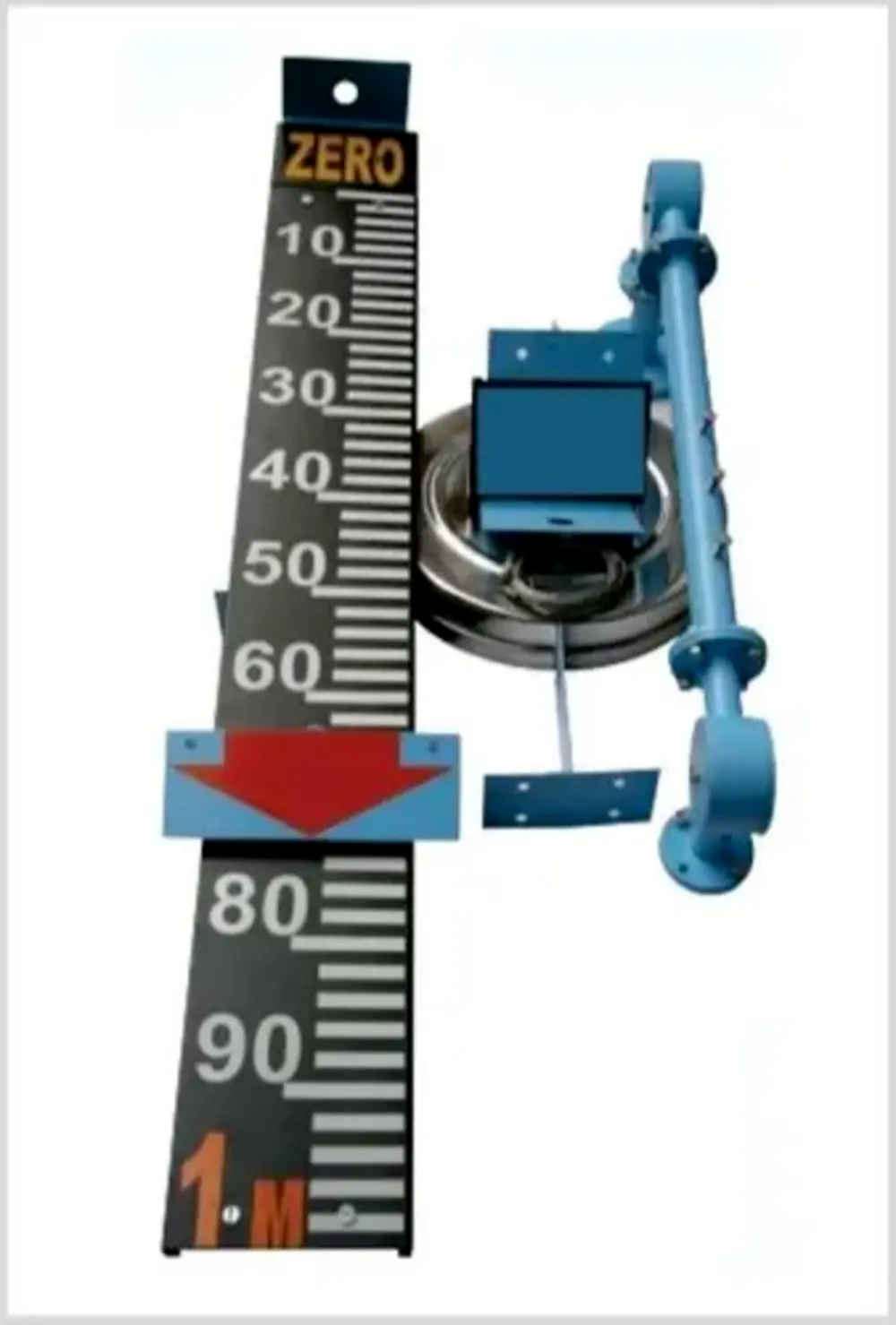 | Level Indicator The Float & Board Level Indicators consists of a float connected to a pointerthrough a rope via a set of pulleys. View product → |
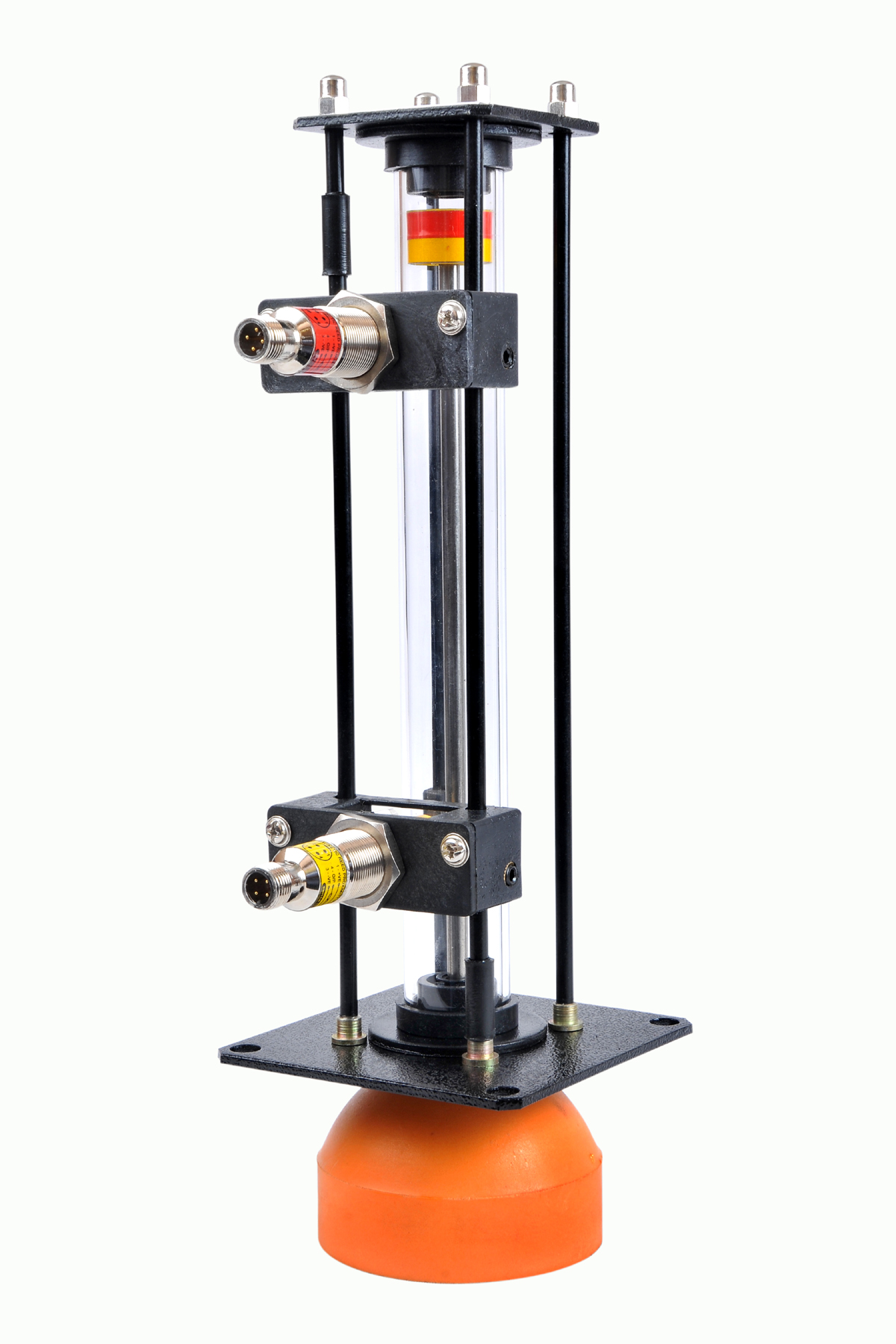 | Level Gauge Oil Level Indicator is designed to indicate the coolant and hydraulic oil level inside the tank with a visual indicator above the tank. View product → |
Frequently asked questions
Which tank level gauge is easiest to read from 10 m or 25 m?
A magnetic level gauge is the strongest local option because its external flags, rollers or pointer show level without requiring you to see the liquid line through glass.
What makes a tank gauge readable from the ground or a walkway?
Specify the viewing distance, viewing angle, display colour contrast, scale size, lighting conditions and whether the gauge is visible from the planned standing point.
How do magnetic, glass, ultrasonic and transmitter gauges compare?
Magnetic gauges provide a clear local visual display; glass gauges depend on seeing the liquid line; ultrasonic gauges provide non-contact measurement; transmitters send level data to a remote control point.
What information should you provide when buying a distance-readable level gauge?
Provide tank dimensions, liquid properties, temperature, pressure, installation height, viewing distance and the required local or remote indication method.