The instrument does not measure volume directly: it times an acoustic echo, converts that travel time into distance, and subtracts the distance from a configured tank reference height. You will be able to trace that calculation, set up the measurement correctly, and recognise when foam, vapour, temperature or tank geometry can make the displayed value unreliable.
Key takeaways
- Convert round-trip echo time into surface distance using the speed of sound.
- Subtract measured distance from tank reference height to calculate liquid level.
- Protect the transducer’s dead zone by keeping the maximum level below its blocked range.
- Verify ultrasonic suitability when vapour, foam, turbulence or changing temperature affects echoes.
From ultrasonic pulse to measured surface distance
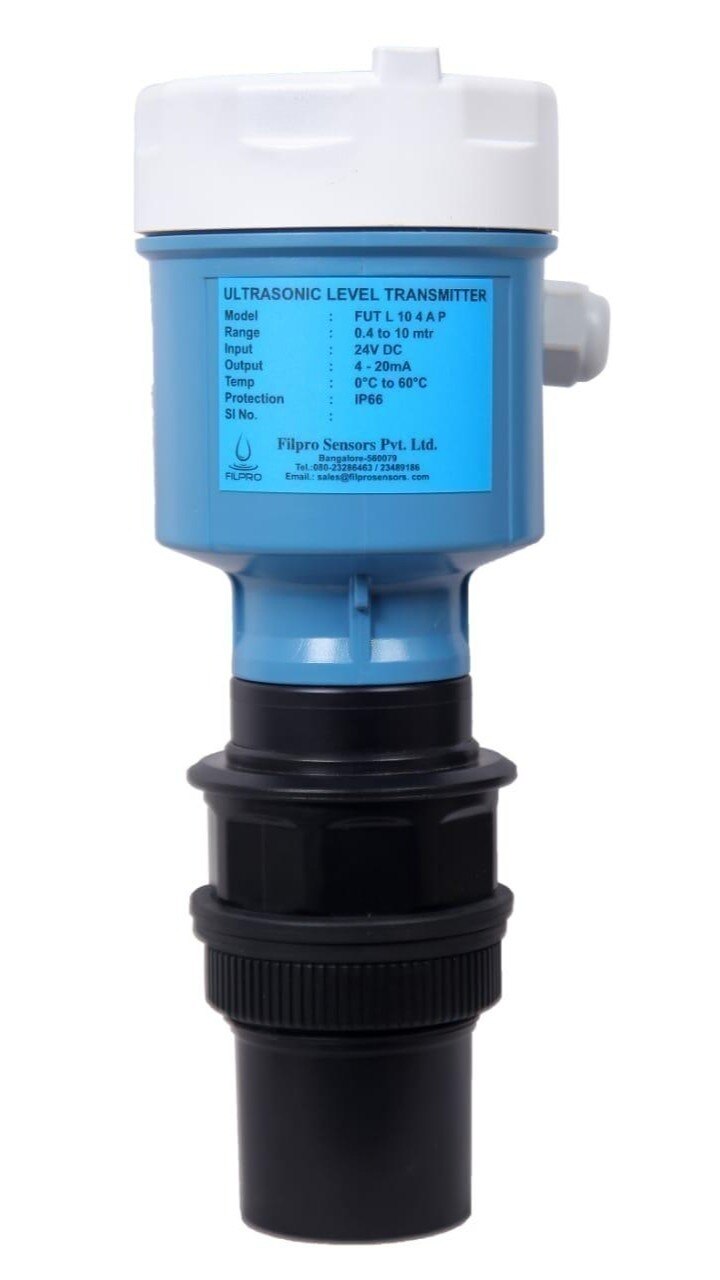
An ultrasonic level transmitter for tanks calculates surface distance from the time taken by an acoustic pulse to travel from its transducer to the liquid surface and return. The transducer emits the pulse, detects the reflected echo, and measures the round-trip time.
The core calculation is d = c × t ÷ 2, where d is surface distance, c is the speed of sound through the tank’s gas space, and t is echo travel time. Dividing by two removes the return journey.
The transmitter subtracts d from the configured tank reference height to calculate liquid level; it does not directly measure volume or mass.
The echo becomes unreliable when the gas-to-liquid interface scatters or absorbs sound. Common causes include:
- Foam on the liquid
- Heavy vapour, mist, or boiling
- Condensation or dust on the transducer
- Severe turbulence
- A false reflection from internal equipment
A near-field blanking zone also exists below the transducer. Keep the highest liquid level outside the manufacturer’s specified blocking distance, or the reading can freeze, disappear, or indicate an implausibly high level.
Enter the correct reference distance, empty distance, and measurement range. A wrong reference height creates a consistently believable error. The transmitter then scales the calculated level to outputs such as 4–20 mA; those values represent configured levels, not automatically the physical empty and full points.
How distance becomes level, volume and a control signal
The transmitter turns measured surface distance into liquid height by subtracting it from a configured tank reference height: level = reference height − distance. If the reference is the transducer face and the tank bottom is 3.0 m below it, a 1.2 m distance represents 1.8 m of liquid height.
An ultrasonic level sensor for tanks cannot measure reliably inside the transducer’s near-field blanking zone. Keep the highest liquid surface below the manufacturer’s blocking distance; filling into that zone can produce a frozen, missing or implausibly high reading. Configure these values correctly:
- Tank reference distance
- Empty distance
- Measurement range
- Output action
A wrong reference height creates a consistently plausible but incorrect level. A wrong empty-range setting can reject a valid echo or limit the reading before the tank is empty.
Level is not automatically volume. A vertical cylindrical tank with a flat bottom can use a geometry calculation, but horizontal cylinders, cones, dished heads and internal displacement require a strapping table or volume table in the transmitter or control system.
The transmitter converts the configured level into a scaled 4–20 mA signal, with digital communications and alarms available on many models. The 4 mA and 20 mA points represent configured levels, not necessarily physical empty and full. A control system can therefore display the wrong engineering value even when the acoustic distance is correct.
Foam, vapour, turbulence and condensation can further make practical accuracy worse than the headline specification.
Mounting the transducer and protecting the dead zone
Mount an ultrasonic level transmitter for tanks on the tank roof, above the normal measurement area, with its face pointing straight down at the expected liquid surface. Keep the acoustic path clear of the inlet stream, ladder, pipe, agitator and other internal hardware.
A tilted transducer can send the strongest echo toward the wall instead of back to the instrument.
Set the installation location by checking these clearances:
- Leave the manufacturer’s specified blocking distance below the transducer. The highest permitted level must remain outside this near-field dead zone; filling into it can freeze the reading, remove the echo or create an implausibly high level.
- Keep walls and internals outside the beam. There is no universal wall clearance: use the stated beam angle and calculate beam radius at each obstruction as path distance × tan(half beam angle).
- Avoid mounting over a filling stream or directly above a sloped, dished or conical bottom. These surfaces can redirect the echo and make the empty reading unreliable.
- Use a short, open-ended mounting nozzle with no weld bead or protrusion in the beam. A long or narrow nozzle can cause ringing and consume the available clearance.
Record the transducer face elevation and enter the correct tank reference distance, empty distance and measurement range. If the reference is wrong, the transmitter can show a stable but incorrect level; if the range reaches into the dead zone, it can reject echoes or limit early. Verify the reading at known liquid levels after installation.
Why temperature, vapour and surface conditions change the reading
The gas above the liquid sets the sound speed used by an ultrasonic level sensor for tanks. Air travels at about 343 m/s at 20 °C, but temperature changes alter that speed; nitrogen, carbon dioxide, solvent vapour and other process gases produce different values.
If the transmitter assumes the wrong gas conditions, it converts echo time into the wrong distance and therefore reports the wrong level.
A built-in temperature sensor corrects for temperature near the transducer, not for every condition in the tank. It cannot remove errors from unknown vapour composition, a temperature gradient along a tall vessel or stratified gas layers.
The liquid surface returns the clearest echo when it is smooth, clean and stable. Conditions that weaken, scatter or redirect the pulse include:
- Foam, which reflects sound from bubbles instead of the actual liquid surface
- Boiling, which creates constantly moving interfaces and vapour
- Heavy vapour, mist or dust, which attenuates the signal through the gas path
- Condensation on the transducer, which absorbs or distorts the outgoing and returning pulse
- Severe turbulence, waves or an active filling stream, which make the reflecting surface change between readings
The result can be a fluctuating level, a lost echo or selection of a false echo from a tank fitting, foam layer or vapour boundary. A headline accuracy figure applies only when the instrument identifies a strong, correct echo; in a difficult tank, surface and gas conditions usually dominate the practical error.
When ultrasonic measurement fits the tank—and when to verify the choice
An ultrasonic level transmitter for tanks fits a clean, relatively calm liquid surface with a clear acoustic path. Choose more carefully when foam, boiling, heavy vapour, condensation, turbulence, internal obstructions or a short measuring range can weaken or confuse the echo.
| Condition | What can go wrong | Selection or commissioning response |
|---|---|---|
| Stable water or chemical surface | The reading is usually governed by installation and configuration, not headline accuracy | Confirm the echo, reference distance, empty distance, range and output action during commissioning |
| Foam, boiling or severe turbulence | The pulse scatters, causing a lost echo, unstable value or false surface | Test under the worst process condition; compare radar or hydrostatic measurement |
| Heavy vapour, mist, dust or condensation | Attenuation or buildup at the transducer reduces signal strength | Check the gas space and transducer temperature; choose another method if the echo is unreliable |
| High-level operation near the dead zone | Filling into the blocking distance can freeze the value or create an implausibly high reading | Keep the maximum level below the manufacturer’s specified dead zone, or use a different mounting range |
| Agitators, pipes, ladders or filling streams | Reflections can compete with the liquid echo | Verify the echo profile after installation and relocate the instrument if required |
Use an ultrasonic level sensor for tanks only after checking the actual surface, gas space and highest operating level, not from the liquid name alone. Filpro Sensors Pvt Ltd can be included in a comparison that asks for those process conditions alongside radar, hydrostatic or capacitance alternatives.
A consistently plausible reading still needs an independent level check before it drives an alarm, pump or filling valve.
Related product
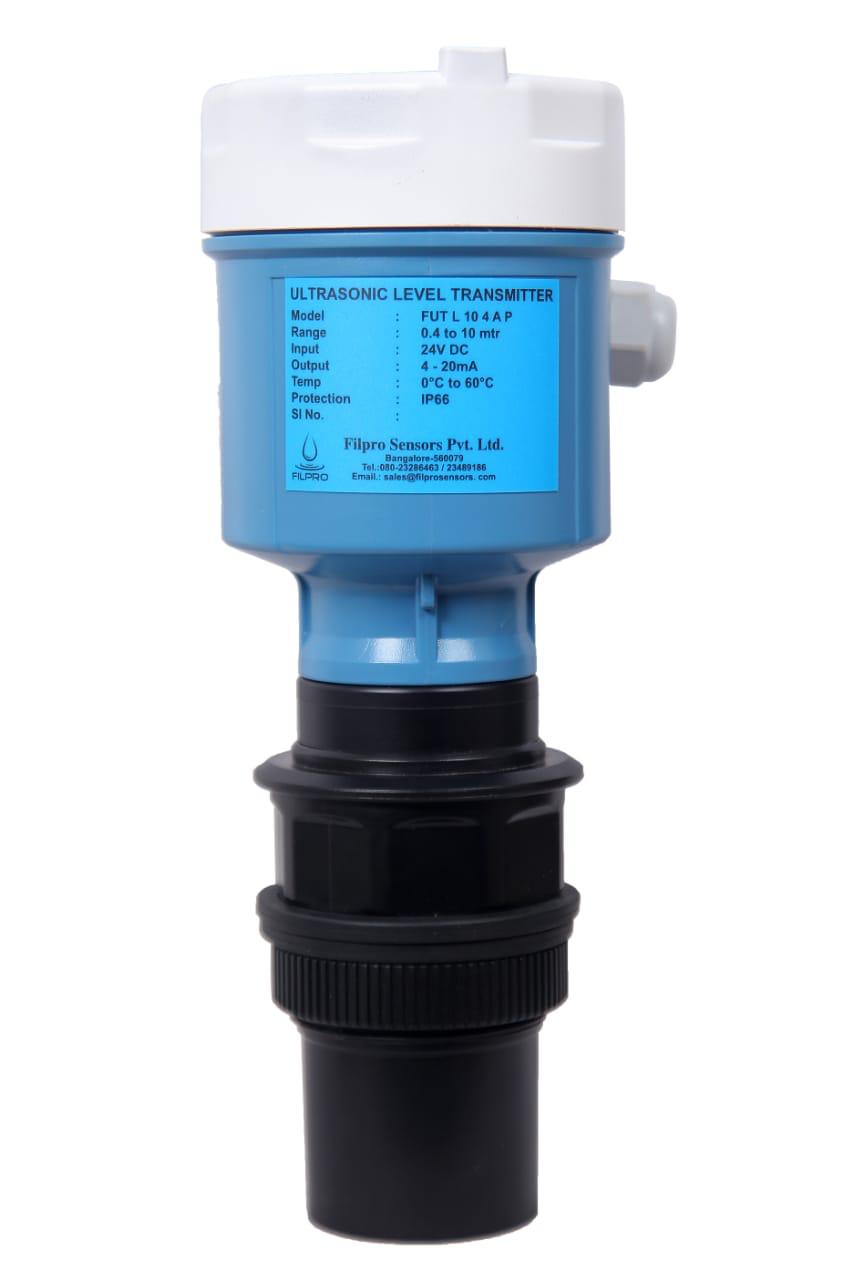 | Level Transmitter Ultrasonic Level Sensor is a non-contact ultrasonic continuous level measurement product based on sound technology. View product → |
Frequently asked questions
How does an ultrasonic level transmitter measure surface distance?
It emits an acoustic pulse, detects the returning echo from the liquid surface, and calculates distance from round-trip travel time and sound speed.
How does measured distance become tank level and volume?
The transmitter subtracts surface distance from a configured tank reference height. It then uses the tank geometry or a level-volume table to calculate volume and can output a control signal.
Where should you mount an ultrasonic transducer on a tank?
Mount it above a clear liquid surface, align it vertically, and keep the highest expected level below the transducer’s dead zone. Avoid nozzles, ladders, agitators and obstructions in the acoustic path.
What can distort an ultrasonic tank level reading?
Temperature changes, vapour, foam, turbulence, condensation, dust and an uneven surface can weaken or shift the returning echo.
When should you verify that ultrasonic measurement fits the tank?
Verify the choice when the tank contains heavy vapour or foam, the surface is highly turbulent, the temperature changes significantly, or reliable echoes cannot reach the transducer.