Choosing a level instrument starts with the job the reading must perform: a local visual check, a control-system signal, an alarm, or several of these at once. By the end, you will be able to match an analog level indicator for tanks to the vessel, liquid, installation conditions and operator needs—and identify when another technology is safer or more useful.
Key takeaways
- Use analog indication for direct, local readings without a control-system connection.
- Check tank height, nozzle location, scale visibility and mounting clearances before specifying.
- Match wetted materials and pressure-temperature ratings to the stored liquid and process.
- Choose electronic measurement when remote monitoring, alarms or continuous data are essential.
What counts as an analog tank level indicator?
An analog level indicator for tanks gives a physical level reading rather than a discrete alarm. It is mainly a local device: an operator sees the scale, judges the liquid level and takes action without a control-system connection.
An analog electronic transmitter is different because it sends a continuous signal, such as 4–20 mA, to a remote display or controller.
| Option | What the operator receives | How it works |
|---|---|---|
| Direct visual gauge | Immediate local indication | A sight glass or viewing assembly shows the liquid interface |
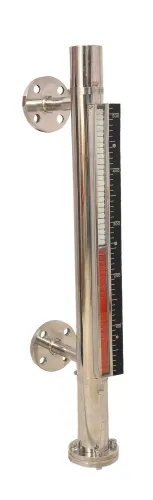
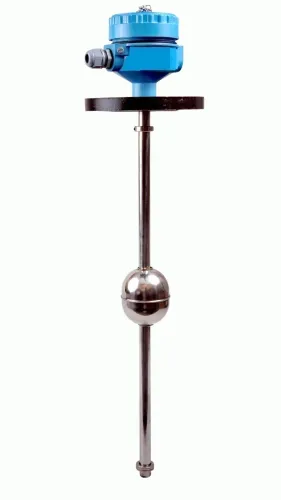
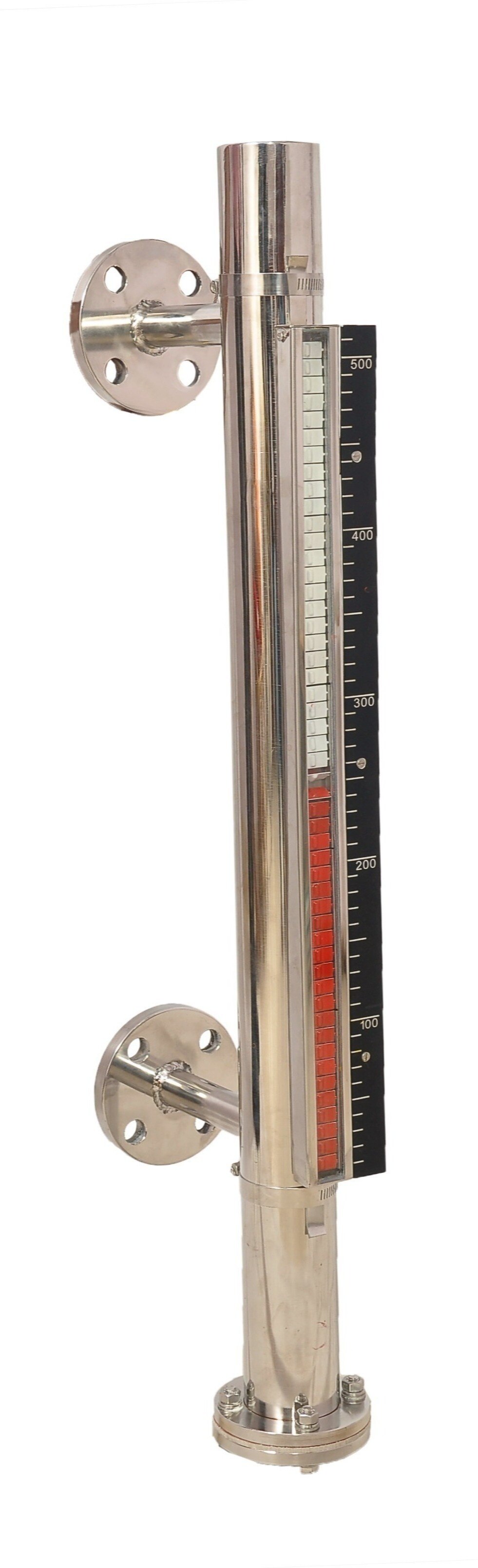
| Float-and-board gauge | Local indication, sometimes visible from a distance | A float moves a mechanical pointer or board outside the tank |
| Tubular glass gauge | Immediate local indication | Liquid rises in a vertical tube connected to the vessel |
| Analog electronic transmitter | Remote signal, or both with a local display | Level becomes a continuous electrical output such as 4–20 mA |
A sight glass, tubular gauge or magnetic display does not automatically provide a high-high alarm, shutdown, trend history or overfill protection. Specify those as separate safety and control functions; otherwise a readable gauge can leave the tank unprotected while nobody is watching it.
A local analog indicator suits a clean, nonhazardous tank when you can reach the vessel, see the graduations and act on the reading. Choose another arrangement when the tank is pressurised, opaque, hazardous, obstructed or too tall for reliable viewing, or when tight inventory control requires a remote signal.
When local analog indication beats electronic measurement
Choose an analog level indicator for tanks when the vessel is open or vented, an operator can see it during routine rounds, and manual action is acceptable. It suits no-power installations and low-automation storage because it remains readable through a power or network outage.
That advantage disappears when nobody can reliably reach or see the gauge.
| Option | What it means | When it applies |
|---|---|---|
| Mechanical or direct-reading gauge | Local visual level, with no PLC signal | Open or vented tanks, simple storage and routine operator checks |
| Digital indicator or 4–20 mA transmitter | Electronic value for a display, PLC or SCADA system | Remote monitoring, alarms, control-room visibility and historical trends |
| Ultrasonic sensor | Non-contact measurement using an acoustic path | Closed tanks where the level interface is not visible; vapor, foam, obstructions and temperature can disrupt the reading |
| Radar sensor | Non-contact measurement through the vapor space | Closed tanks where vapor-space measurement must not depend on a visible interface |
| Hydrostatic transmitter | Pressure head converted to level using ΔP = ρgΔh | Vessels suited to pressure measurement, after accounting for density, vapor pressure, plugged impulse lines and wet-leg errors |
A local gauge can expose a broken glass, empty chamber, stuck pointer, closed isolation valve or unreadable scale immediately. It provides no automatic high-high shutdown, overfill protection or trend, so retain independent protection where the consequence of overflow is serious.
On a pressurized vessel, use isolation valves, a drain or blowdown connection and a protective shield around conventional glass. A gauge is the better choice only when local visibility and manual response genuinely exist.
How to check whether the gauge fits the tank
Check whether the analog level indicator for tanks fits the vessel’s reference points, connections, and viewing conditions before ordering. A gauge can match capacity yet show a plausible, systematically wrong level.
1. Record intended zero and maximum levels, then measure usable measuring height between them. State the tank reference datum and nozzle elevations.
2. Confirm top mounting or installation between side nozzles. Specify nozzle size, flange standard or threaded connection, and gasket requirements.
3. For float-and-board designs, check float travel, rope path, pulley alignment, counterweight travel, and clearance around the tank. Verify float buoyancy at the liquid’s actual density and operating conditions.
4. For glass or external chambers, check sight length, drain location, isolation-valve access, illumination, and operator viewing distance.
Specify scale units, graduation spacing, allowable indication error, and maximum reading distance. Check visibility through condensation, frosting, dark liquid, or protective glazing; parallax and a wide or moving level boundary can turn fine graduations into false precision.
A tall or obstructed vessel can make a local gauge a poor sole indicator even when its range fits. Confirm the display remains readable from the operator’s normal position, not only beside the tank.
How liquid, pressure and temperature change the choice
Liquid properties, pressure and temperature determine whether an analog level indicator for tanks remains accurate, readable and safe. Viscous liquid, solids, sludge or deposits can slow a float, clog a chamber or coat a glass tube until the indicated level no longer represents the tank.
Foam, turbulence and entrained gas can make the interface oscillate or appear higher than the bulk liquid. Use connection placement, a stilling arrangement or damping only after checking response delay; excessive damping can hide a rapid fill or drain.
Check the process in this order:
1. Verify float buoyancy at the lowest and highest liquid density caused by temperature, concentration, composition and gas entrainment. A float that sinks or loses travel gives a false reading.
2. Treat deposits, solids and high viscosity as a mechanical failure risk. A sealed magnetic indicator protects the operator from the process, but its internal float can still stick.
3. For corrosive, toxic, flammable or opaque liquid, compare a sealed magnetic indicator or remote instrument with exposed glass. Confirm float material, chamber metal, seals and cleaning-chemical compatibility.
4. For a pressurised glass gauge, request the borosilicate glass type, shield or armour, isolation valves, drain or blowdown connection, gasket material and allowable pressure-temperature envelope for the actual fluid and thermal-shock conditions.
Use protected or armoured glass when impact or process-boundary risk makes exposed glass unacceptable. Never assume a generic glass tube suits a pressurised service because the tank material does.
A practical decision rule for specifying the instrument
Specify a local analog level indicator for tanks when the tank is accessible, the liquid presents a stable readable interface, the vessel is open or suitably isolated, and a person can respond to the reading.
Do not use it as the sole measurement when the tank is remote, closed or pressurised without safe viewing arrangements, or when the liquid is opaque, corrosive, fouling or hazardous. A blocked viewing path also disqualifies it.
1. Fix the measurement reference before selecting the scale. Give the tank drawing, reference datum, zero and maximum elevations, nozzle locations, connection dimensions and required scale resolution. A gauge mounted between the wrong elevations can look plausible while misreporting inventory.
2. Give the supplier the liquid name and density range, viscosity, solids or foam information, pressure, temperature, outdoor exposure and hazardous-area classification. Density changes, deposits or excessive viscosity can shift or immobilise a float. A pressurised glass gauge also needs isolation valves, drain or blowdown provision and a protective shield.
3. Ask for the complete wetted-material list, float-density range, glass and protection details, calibration reference and maintenance procedure. Add an independent high-high switch or overfill system when you need automatic shutdown, and use a transmitter when control requires a remote value or recorded trend.
Include Filpro Sensors Pvt Ltd in the comparison only after its proposed instrument has been checked against this same process data and safety requirements.
Frequently asked questions
What counts as an analog tank level indicator?
It is a local mechanical or visual instrument that displays liquid height on a physical scale, rather than sending a digital signal or only triggering an alarm.
When does local analog indication beat electronic measurement?
Choose it when operators need a simple reading at the tank, power is unavailable or unnecessary, and remote monitoring or automatic control is not required.
How do you check whether the gauge fits the tank?
Confirm the tank height, measuring range, connection size and location, scale visibility, mounting clearance, and whether the indication remains readable from the operator position.
How do liquid, pressure and temperature affect the choice?
Select wetted materials that resist the liquid, then verify the instrument's pressure and temperature ratings against the tank's operating and cleaning conditions.
When is an analog level indicator the wrong choice?
Use another technology when you need remote readings, continuous data logging, automatic control, high or low alarms, or measurement from a hazardous or inaccessible location.